Distribution of Functions in Microbiomes
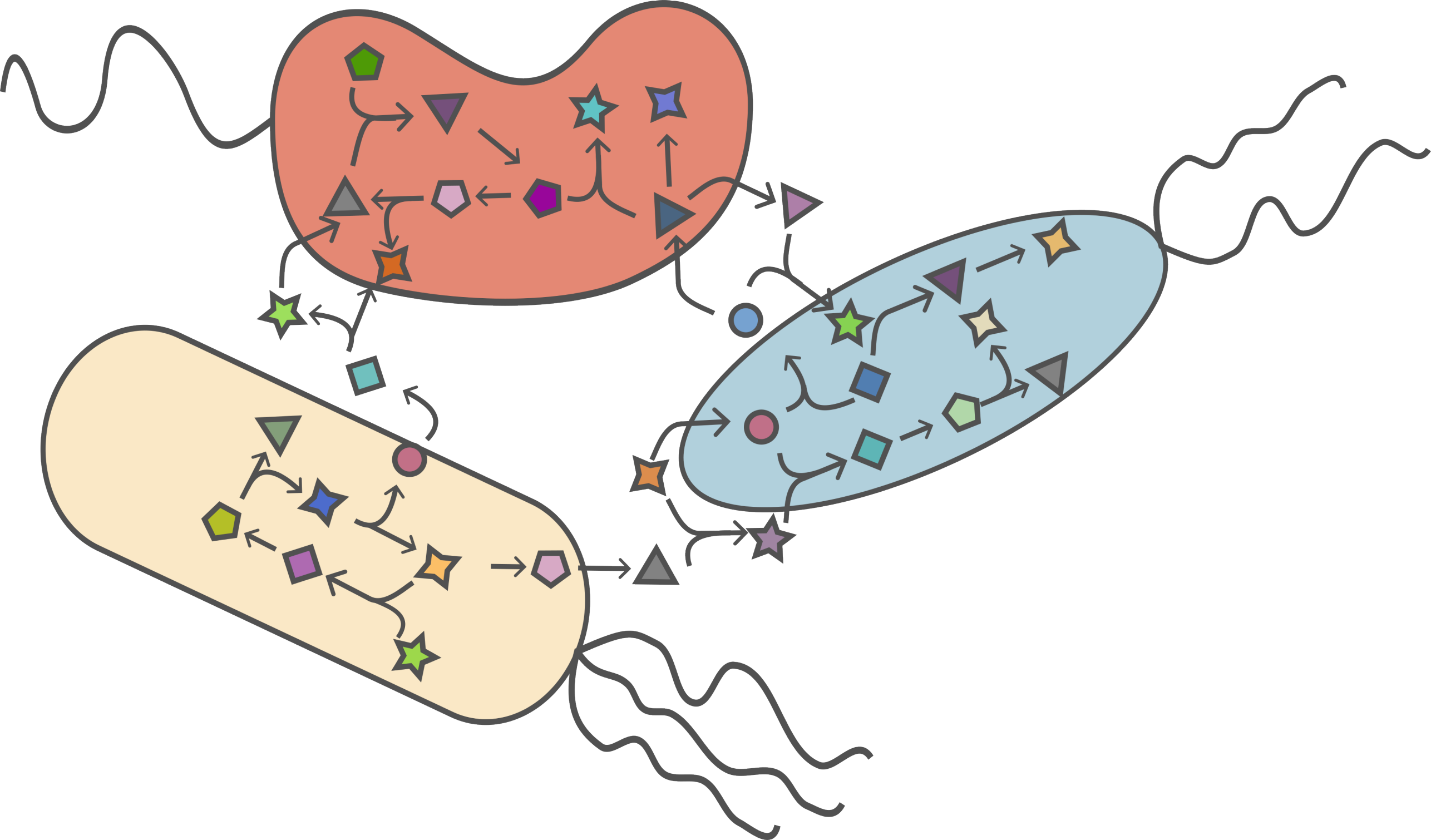
Microbes live in complex communities where they interact in various ways with other microbes. One type of interactions is the exchange of metabolic intermediates among microbes with different metabolic capabilities. This results in a distributed, collective metabolism. The organising principles, structure and features of these distributed metabolic networks are not well understood. We explore:
- What factors that determine the degree of metabolic distribution in microbial ecosystems (Alyssa)
Dynamic microbial interactions and stable coexistence
Microbes live in diverse communities that perform essential functions in ecosystems, hosts, and engineered environments. Many of these functions appear remarkably stable, even though the communities that produce them are composed of many interacting species whose abundances, activities, and environments change over time. A central challenge in microbial ecology is therefore to understand how microbes coexist stably, and how this coexistence supports the reliable functioning of microbial communities.
Our research investigates how temporal variability in physicochemical context shapes microbial coexistence and function. We focus on how microbes consume resources over time, how different nutrient utilisation strategies allow species to coexist, and how interactions between species can shift over time as resources are depleted and metabolites accumulate. In parallel, we study how functional redundancy and bacterial interaction networks buffer community functions against disturbance. Together, these projects address fundamental questions of how dynamic interactions among microbes give rise to stable coexistence and stable ecosystem services. (Anna, Megan)
Physiological models for communities and in non-steady-state environments
Marine microbes play a significant role in the global carbon cycle by breaking down organic matter. However, predicting how these complex communities respond to climate change, such as rising temperatures and ocean acidification, remains a major challenge. While we have a good grasp of how individual species react to these stressors, we know much less about what happens in diverse communities where populations and interactions constantly shift. By observing how communities interact, compete, and adapt under changing conditions, we are developing new predictive models to understand the future of the marine carbon cycle. Specifically, we work on:
- Predicting marine microbial community response to rising temperatures and acidification through proteome allocation. (Nittay)
- Mathematically modelling distributed metabolism in microbial communities, taking into account temporally and spatially heterogeneous conditions. (Benjamin)
Predictive phage ecology across scales
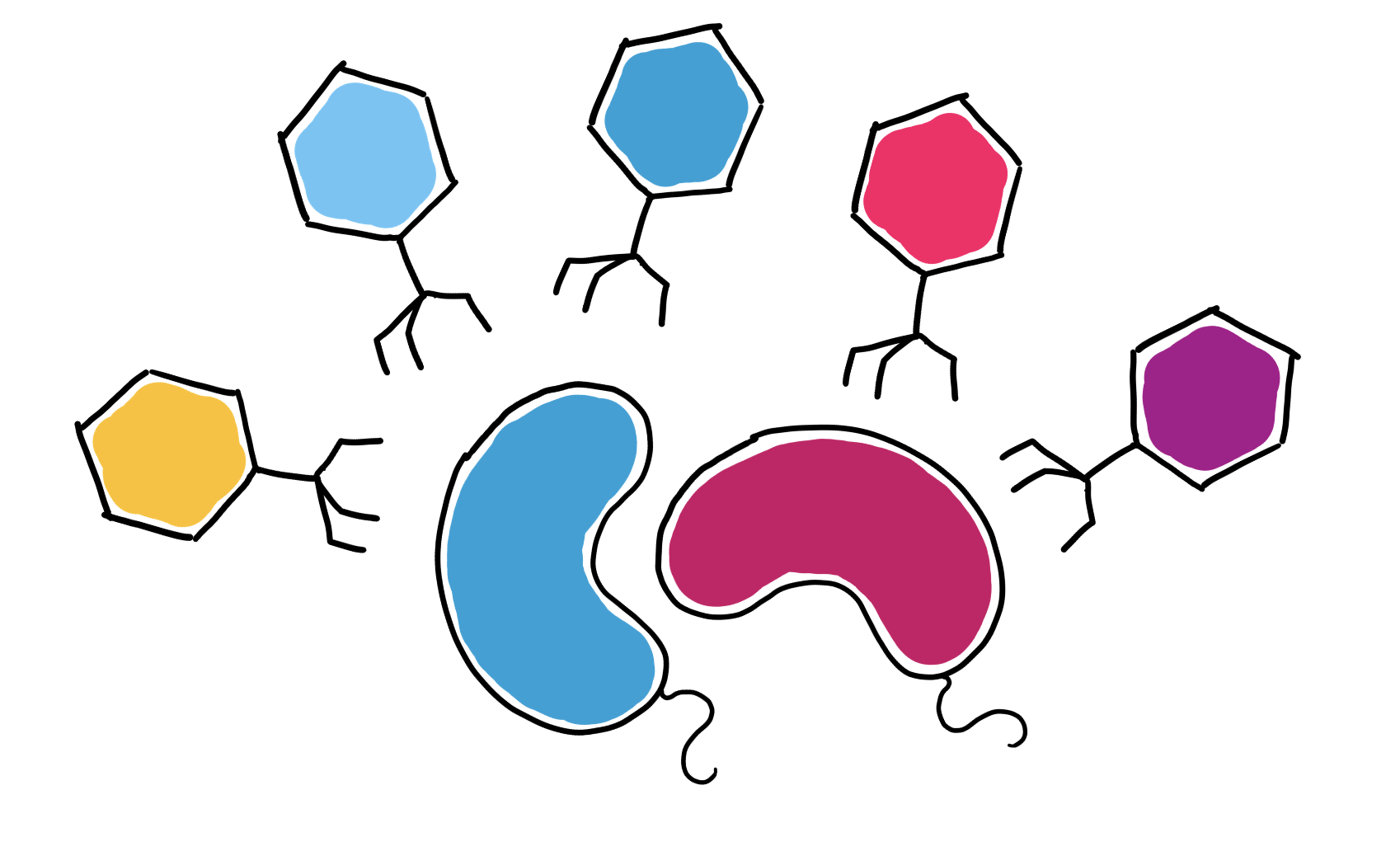
Viruses are everywhere life exists, including within the bacterial communities that support life across Earth in soils, oceans, and ourselves. The viruses that infect bacteria – known as phages – are so abundant that they often outnumber their bacterial hosts. Phages transform the membership and activities of bacterial communities, which in turn impacts the health of ecosystems around the globe. Therefore, it is essential that we understand how they are being affected by the climate crisis – both to predict how our world is changing and to harness the power of microbiomes to create a more sustainable future.
We are currently far from being able to predict how interactions between phages and bacteria shape the ecosystem-level functions of microbial communities. Our research addresses several questions about phages across scales of ecological complexity: Do trade-offs in phage traits define ecological strategies? How do bacterial physiology and environmental factors tune phage-host interactions? And which phage and host traits are predictive of their dynamics? For this research, we are using both model phages and natural phage-host populations from plant microbiomes, which harbor enormous, unexplored viral diversity and are key targets for sustainability-oriented microbiome engineering. (Rachel)